 PlateyGet the app
Lifting Plateau: Check Your Log Before Changing Your Program
A plateau is weeks stuck at one weight, not one bad session. Define it from your log, run five checks, and try a hold or a deload before switching programs.
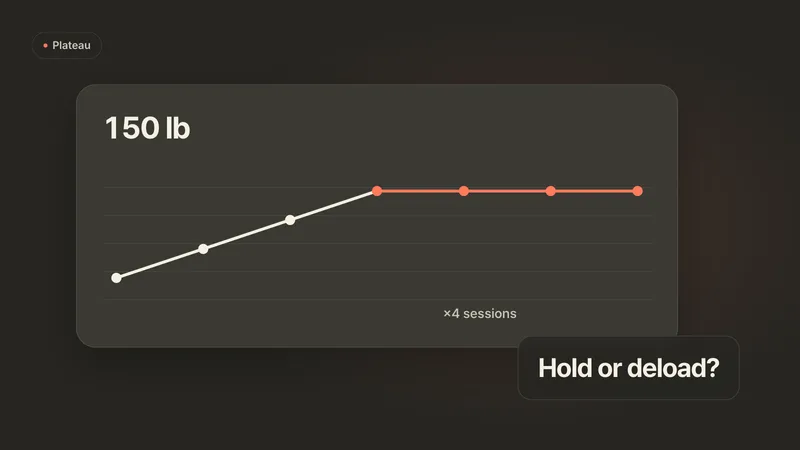
The weight has not moved in a while, and a new program looks tempting. Before you switch, open your log. A lifting plateau is being stuck at the same weight for weeks despite consistent training, and most stalled stretches turn out to be one bad session, a recording problem, or normal slowdown. Use your history to decide what to do. Identify the stall in your log and check the entries. Then hold the weight steady and try a deload before you consider switching programs.
What counts as a plateau
The StrongLifts plateau guide (updated March 4, 2024, checked Nov 28, 2026) defines it as being stuck at the same weight you were lifting several weeks, or months, ago while going to the gym consistently and putting in the effort. The guide rules out two common experiences:
- You can still make progress when sets take more effort than before and you need bigger breaths between reps.
- It's normal to add weight less often than you did as a beginner.
Its worked example: bench 175 lb for 5x5, move to 180 lb (about 82 kg) and fail, repeat and fail, deload, climb back to 180 lb and fail again, repeat twice more. Six weeks without getting past 180 lb: that is a plateau. One missed session is not.
This hypothetical log shows an earlier stage. Over four sessions, the lifter tries to complete 5x5 at 135 lb (about 61 kg):
| Session | Reps per set at 135 lb | What the failure guide says |
|---|---|---|
| 1 | 5, 5, 5, 4, 3 | Missed. Repeat the weight |
| 2 | 5, 5, 5, 4, 4 | More reps, still short. Repeat |
| 3 | 5, 5, 4, 4, 3 | Still short. Repeat |
| 4 | 5, 5, 5, 4, 2 | Third failed repeat. Deload |
After those four sessions at the same weight, the guide recommends staying with the program and taking a deload.
Five checks before you blame the program
The plateau guide lists program hopping as a common mistake: the program is only one part of the puzzle, alongside sleep, recovery, rest periods, technique and consistency. Some of those leave traces in your log. Check these five before concluding anything:
- Missing sessions. Scan the dates. If the "stalled" month contains two workouts instead of eight, the log shows a consistency gap, not a strength ceiling.
- Mixed units. If some rows are lb and some kg, the same exercise can look flat or jumpy when it is neither. Convert the history to one unit before reading the trend.
- Set definitions. Warm-ups counted as working sets change every total. If your log has no set-type column, that is the first thing to add; see What to Write in a Workout Log.
- Rest periods. The same 135 lb can produce 5, 5, 5, 5, 5 with long rests and 5, 5, 4, 3, 3 with short ones. If you note rest lengths or session conditions, compare the missed sessions against the completed ones.
- Plan versus actual. Are you comparing the same exercise and the same target each week? A log that mixes a 5x5 day and a 3x8 day at the same weight is not one trend line.
These are checks on the record, not training prescriptions. If a check finds a recording problem, fix it and re-read the trend.
Hold first, deload second
The StrongLifts failure guide gives the sequence for missed reps. After one failed session, repeat the weight and try to do more reps than last time; its rationale is that a single bad day (rushed, distracted, a setup mistake) does not mean you need to reduce load. If you repeat the weight three times and still fail, the guide says to stop trying and deload: reduce the weight by about 10% and work your way back up.
About 10% off 135 lb is 121.5 lb, which loads as 120 lb with 5 lb steps. To make sense of those weights later, keep two details in your log:
- Mark the deload weeks with a note or set type. Without that reminder, you'll read 135, 135, 120, 125, 130 as a collapse instead of a planned reset.
- Record both the reduced load and the weight you're working back up to so you can see the target.
If you use a rep-range method instead of fixed 5x5, the same logic applies one step earlier: hold the weight and add reps inside the range before you add load, as in Double Progression.
Before you switch programs
If your log checks out and you're still stuck at the same weight for weeks after holding and deloading, consider a program change. The ACSM 2009 position stand recommends different loading ranges and frequencies for novice, intermediate and advanced lifters, and says recommendations should be applied in context, contingent on goals, physical capacity and training status. A program that fits a different training status is not automatically an upgrade.
Whatever you choose, keep the history. Export the old log before you delete anything, so the next program starts with your actual numbers instead of guesses. And if the stall comes with pain rather than just missed reps, ask a professional for advice.
Where Platey fits
Platey uses your last session to suggest a weight and rep count for the next workout and gives a one-line reason. When you meet its deload conditions, it suggests a lighter week. You choose whether to apply it, and you can export your own record to CSV either way.
Summary
- A plateau is weeks stuck at one weight despite consistent training. Struggling and slow progress are not plateaus.
- Check the log first: missing sessions, mixed units, set definitions, rest periods, plan versus actual.
- One miss: repeat the weight. Three failed repeats: deload about 10% and climb back, and write it down.
- Switch programs only after the checks and the deload, and take your history with you.
Sources
- StrongLifts 5x5: Plateaus (definition, struggling and slow progress are not plateaus, program hopping; updated March 4, 2024, checked Nov 28, 2026)
- StrongLifts 5x5: What If You Fail Reps (repeat the weight, deload about 10% after three failed repeats; updated March 4, 2024, checked Nov 28, 2026)
- American College of Sports Medicine position stand: Progression models in resistance training for healthy adults (2009), abstract via NCBI E-utilities, PMID 19204579