 PlateyGet the app
Linear Progression vs Double Progression: When to Add Weight
Linear progression adds weight after completed sessions; double progression fills a rep range first. StrongLifts increments, ACSM percentages, worked examples.
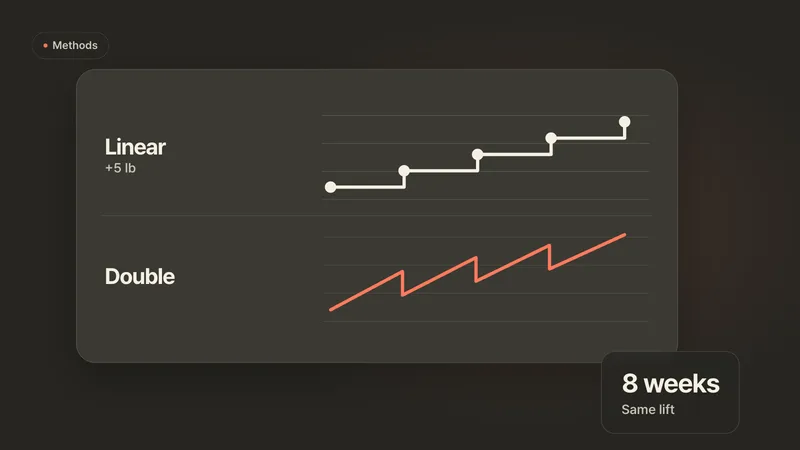
You hit 5 sets of 5 at 135 lb (about 61 kg) last session. Is today 140 lb, or 135 lb again? Linear progression and double progression are the two common rules for answering that, and they differ on one thing: when the weight goes up.
Linear progression: add weight when you complete the session
Linear progression adds a fixed step after every session where you hit the target. The StrongLifts 5x5 guide says to add weight next time if you completed every set. If you fell short of 5x5, use the same weight and try for more reps than last time (official guide, updated March 4, 2024, checked Nov 28, 2026).
The target is fixed, usually 5 reps per set. Each time you complete the target, you add weight for the next session. Those small, frequent increases work well early on.
Double progression: fill the rep range, then add weight
With double progression, you pick a rep range, say 8 to 12. Stay at one weight until every working set reaches 12, then add the smallest step you can load and start again at 8. Inside the range, the weight holds and you aim for one more rep. The full rule set, with worked examples, is in Double Progression Method: How to Pick Your Next Weight.
With linear progression, you add weight after every completed session. With double progression, you add weight once you reach the top of the range on every set.
How big one step should be
StrongLifts' official guide sets the default increment at 5 lb (2.5 kg), which is a 2.5 lb plate per side (1.25 kg per side in metric). It splits the recommendation by exercise:
| Lifts | StrongLifts recommended increment |
|---|---|
| Squat, deadlift (big muscles) | 5-10 lb / 2.5-5 kg |
| Bench, overhead press, row (small muscles) | 2.5-5 lb / 1.25-2.5 kg |
Small muscles move lighter loads, so they get smaller steps. The smallest increase you can make with your gym's plates is twice the weight of its smallest plate. With 2.5 lb plates that is 5 lb, and with 1.25 kg plates it is 2.5 kg. Plate Math works out the combinations.
The same step is a different percentage
The ACSM 2009 position stand recommends a 2-10% load increase once you can perform the current workload for one or two repetitions over the target. A fixed step does not stay inside that band at every load.
- 5 lb on a 200 lb squat: 2.5%
- 5 lb on a 135 lb bench: about 3.7%
- 5 lb on a 100 lb press: 5%
- 5 lb on a 40 lb dumbbell: 12.5%
On light implements, one step can exceed the 10% end of the recommendation. Dumbbells and machines usually move in fixed jumps you cannot shrink, which is a practical argument for progressing with reps first on those exercises.
Same log, different decision
For a session at 135 lb with a 5 lb step, Platey's code gives the double-progression suggestions below. The linear suggestions follow the StrongLifts rule.
| Method (target) | Last session | Next session |
|---|---|---|
| Linear (5x5) | 135 lb: 5, 5, 5, 5, 5 | 140 lb for 5x5 |
| Linear (5x5) | 135 lb: 5, 5, 5, 4, 3 | 135 lb again, aim for more reps |
| Double (8-12) | 135 lb: 12, 12, 12 | 140 lb for 8 |
| Double (8-12) | 135 lb: 12, 12, 11 | 135 lb, aim for 12 on all sets |
Which method fits depends on how you train. Linear progression suits lifters who train the main lifts two or three times a week and want to add weight every session. Double progression gives you room to add reps before increasing the load. It also suits lifts you train once a week. Both stall eventually; when the weight has not moved for weeks, check your log before changing the program. If you have pain or an injury, get advice from a professional.
How Platey's rule is set up
Platey's next-weight suggestion uses double progression with a default range of 8 to 12, and the step is twice the smallest plate in your gym settings. It is one implementation of the second column above, not a claim that double progression suits every lifter.
Summary
- Linear: fixed target reps, add a step after every completed session, repeat after a miss.
- Double: fixed rep range, add reps first, add a step when every set hits the top.
- StrongLifts' default step is 5 lb (2.5 kg), smaller for bench, press and row.
- A fixed step is a bigger percentage on lighter loads; past roughly 10%, reps-first progression is the gentler option.
Sources
- StrongLifts 5x5: How to Progress (default 5 lb / 2.5 kg increments, per-exercise ranges, repeat the weight after a miss; updated March 4, 2024, checked Nov 28, 2026)
- American College of Sports Medicine position stand: Progression models in resistance training for healthy adults (2009), abstract via NCBI E-utilities, PMID 19204579