 PlateyGet the app
Double Progression Method: How to Pick Your Next Weight
Double progression means filling a rep range first, then adding weight. Three rules, worked examples, and what the ACSM position stand actually says.
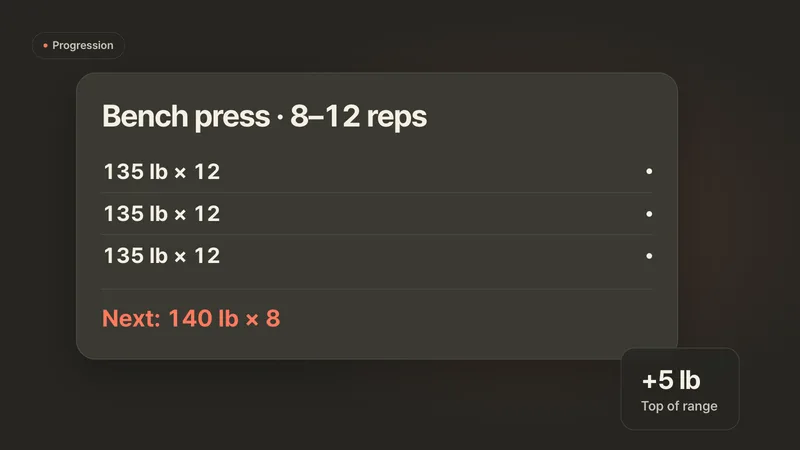
You did 3 sets of 12 at 60 kg last week. What goes on the bar today?
A common answer is a feeling: "that was easy, so... a bit more?" Double progression replaces the feeling with a rule you can apply from your log alone. It is also one of the simplest progression methods to explain.
The idea in one line
Pick a rep range. Add reps at the same weight until every working set reaches the top of the range, then add weight and drop back to the bottom of the range. The method takes its name from those two increases.
Suppose your range is 8 to 12 reps.
- Train at one weight and aim to add a rep to your sets over the weeks.
- When every working set hits 12, that weight is done.
- Add the smallest jump you can load and start again at 8 reps.
The three rules
| Last session | Next session |
|---|---|
| Every working set hit the top of the range (12) | Add one step of weight, start at 8 reps |
| Every set was at least 8 reps, but not all hit 12 | Same weight, one rep more than your best set (cap at 12) |
| Any set fell below 8 reps | Same weight, back to 8 reps |
If you log any set at the effort cap (RPE 9.5 or higher), Platey keeps the same weight even when every set reached 12 reps.
What counts as "one step"? With a barbell it is twice the smallest plate you own (one plate on each side). With 1.25 kg plates that is 2.5 kg; with 2.5 lb plates it is 5 lb. For dumbbells, which have no plates to add, we'll assume 2.5 kg.
Worked examples
The bench press examples use a 20 kg bar and a gym’s 1.25 kg plates. Each example has three working sets.
| Last session (kg × reps) | Next session | Why |
|---|---|---|
| 60 × 12, 12, 12 | 62.5 kg × 8 | Every set reached the top |
| 60 × 12, 12, 11 | 60 kg × 12 | One set is still at 11 |
| 60 × 10, 9, 8 | 60 kg × 11 | All in range; best set was 10, so 10 + 1 |
| 60 × 8, 8, 6 | 60 kg × 8 | One set dropped below the range, so hold |
| Dumbbell 20 × 12, 12, 12 | 22.5 kg × 8 | Dumbbells assumed to move in 2.5 kg steps |
Platey's progression code gives these results for the sets shown. You can check the first increase by hand: 60 + 1.25 × 2 = 62.5.
After two missed sessions in a row, the rule keeps the weight the same. When to reduce load (a deload) is a separate decision with its own rule.
Why 8–12?
The American College of Sports Medicine's 2009 position stand recommended loads in the 8 to 12 repetition-maximum range for novices. For intermediate and advanced lifters it recommended a wider 1 to 12RM range varied over time, with eventual emphasis on heavy loading. The same document suggests increasing load by 2% to 10% once you can do one or two reps more than the target on your current load.
- The range of 8 to 12 reps is a guideline. If your goal is maximal strength, you will likely spend time in lower rep ranges too.
- One step is a different percentage at different loads. On a 60 kg bench, 2.5 kg is about 4.2%, inside ACSM's range of 2% to 10%. On a 20 kg dumbbell, the same 2.5 kg is 12.5%, above it. Light implements make every step a bigger jump.
A short history, so the name makes sense
According to a 2012 paper by Todd and colleagues, Army physician Thomas DeLorme tried a new rehabilitation method in 1945: patients lifted their 10-repetition maximum for multiple sets. By 1948 he had refined it into three sets of ten, each heavier than the last, and called it Progressive Resistance Exercise. "Progressive overload" is the same principle written more generally: raise the demand on the muscles gradually. Along with weight, you can adjust volume, intensity and rest between sets.
What this rule can't do
- To use the rule, you need a log of what you lifted on each set last time. For what to write down, see What to Write in a Workout Log.
- Different lifts and different people may suit different ranges.
- If you have pain or an injury, ask a professional for advice.
Summary
- Choose a rep range. When every working set reaches the top, add one step of weight.
- Inside the range, repeat the weight and aim for one more rep. If any set falls below the range, hold the weight.
- A "step" is twice your smallest plate, and it is a bigger percentage on light loads.