 PlateyGet the app
How to Count Weight on a Barbell: Bar, Plates, Collars
Count the plates on one side, double it, then add the bar. Bar weights, color-coded kg plates, collars, worked examples, and the mixed lb/kg trap.
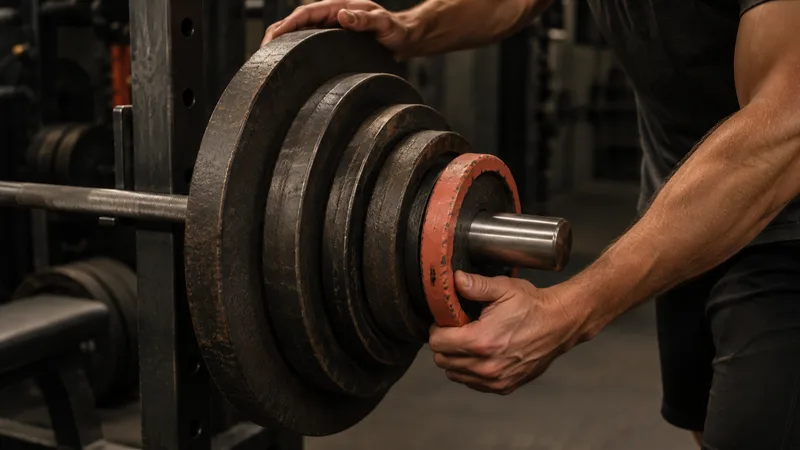
Count the plates on one side of the bar, double that number, then add the bar. A 45 lb bar with a 45 and a 25 on each side is 45 + 25 = 70 per side, so 2 × 70 = 140, plus 45 = 185 lb. The bar is part of the load, and bars weigh different amounts, so check which one you are holding before you trust the total.
Count one side, then double it
Total = bar + 2 × (plates on one side).
Count one side only. It halves the adding, and it doubles as a balance check: if the two sides do not match, fix that before you lift.
Worked example in pounds, one side holding 45 + 25 + 10:
- One side: 45 + 25 + 10 = 80 lb
- Both sides: 2 × 80 = 160 lb
- With a 45 lb bar: 160 + 45 = 205 lb
Worked example in kilograms, one side holding 25 + 20 + 10:
- One side: 25 + 20 + 10 = 55 kg
- Both sides: 2 × 55 = 110 kg
- With a 20 kg bar: 110 + 20 = 130 kg
A faster habit is to count in pairs, since plates go on two at a time. In pounds, a pair of 45s adds 90, a pair of 25s adds 50, a pair of 10s adds 20. In kilograms, a pair of 25s adds 50, a pair of 20s adds 40, a pair of 15s adds 30, a pair of 10s adds 20. Add the pairs, then add the bar.
Going the other direction, from a target weight to plates, is the same equation rearranged: see Plate Math: How to Work Out What to Load on Each Side of the Bar.
Check the bar before you count
The bar is the number people get wrong most often, because several bars look similar on a rack.
| Bar | Weight | Notes |
|---|---|---|
| Men's Olympic / power bar | 20 kg (44.1 lb) | Competition standard |
| US gym bar labelled 45 lb | 45 lb (20.4 kg) | Common practice in lb gyms |
| Women's Olympic bar | 15 kg (33.1 lb) | Shorter shaft, thinner grip |
| Training bar labelled 35 lb | 35 lb (15.9 kg) | Not the same as a 15 kg bar |
| EZ curl bar, trap bar, safety-squat bar | Varies | Weigh it or read the label |
The conversions use the exact definition of a pound, 0.45359237 kg. So 20 kg is 20 ÷ 0.45359237 = 44.09 lb, and 15 kg is 33.07 lb. A "45 lb" bar and a 20 kg bar are close but not identical, and a 35 lb bar is nearly a kilogram heavier than a 15 kg bar.
EZ curl bars and fixed studio bars are not standard, so do not assume 45 lb (20 kg) for them. If nothing is printed on the bar, weigh it: stand on a bathroom scale holding the bar, note the number, then step on without it and subtract. The difference is the bar. Do that once, write it on a bit of tape, and you never have to guess again.
Reading color-coded kg plates
Competition kilogram discs follow the weightlifting color code, and many kg gyms buy plates in those colors as common practice:
| Color | Plate | Pair adds |
|---|---|---|
| Red | 25 kg | 50 kg |
| Blue | 20 kg | 40 kg |
| Yellow | 15 kg | 30 kg |
| Green | 10 kg | 20 kg |
| White | 5 kg | 10 kg |
Small change plates repeat the sequence: red 2.5 kg, blue 2 kg, yellow 1.5 kg, green 1 kg, white 0.5 kg.
Once you know the colors you can read a bar at a glance. Red and blue on each side: 25 + 20 = 45 per side, 2 × 45 = 90, plus the 20 kg bar = 110 kg. Two reds on each side: 2 × 50 = 100, plus 20 = 120 kg. Red, blue and green per side is the 130 kg example above.
The code applies to kg discs, not to pound plates, and cheap gym plates are sometimes colored without following it. Read the number stamped on the plate when you are unsure.
Collars and the mixed lb/kg trap
Do collars count?
Gyms usually leave spring collars and plastic lock collars out of the total, though no rule says to. Competition collars are weighed as part of the load, so if you are matching a competition number, include them. Either way, pick one convention and keep it, otherwise two entries that look identical in your log are not the same lift.
When the gym mixes units
One pound is exactly 0.45359237 kg, so a 45 lb plate is 45 × 0.45359237 = 20.41 kg. That is 0.41 kg more than a 20 kg plate, and it adds up.
Take a 20 kg bar loaded with two 45 lb plates on each side. It looks like 100 kg, but:
- Plates: 4 × 20.41 = 81.64 kg
- Total: 20 + 81.64 = 101.6 kg
In pounds the same bar is 44.09 + (4 × 45) = 224.1 lb, not 225 lb. The total sits just shy of the round number, and next week's "same" load may be a different load if the plate mix changes.
Convert everything to one unit before you add, log in that unit, and note the plate sizes when the gym has both sets. Platey suggests your next weight and reps from your last session and has a plate calculator, so the arithmetic stays in one place. The log stays on the phone and there are no ads.
Summary
- Total = bar + 2 × one side. Count one side, double it, add the bar.
- Confirm the bar first: 20 kg (44.1 lb), 45 lb (20.4 kg) and 15 kg (33.1 lb) are three different loads.
- kg colors: red 25, blue 20, yellow 15, green 10, white 5. Check the stamp if the plates look off.
- Decide once whether collars count, then keep that rule in every entry.
- With mixed plates, convert first: a 45 lb plate is 20.41 kg, not 20 kg.